The Birdcage Review: A Sharp, Warm, and Still-Winning Comedy About Family, Performance, and Acceptance
Few comedies from the 1990s have aged with as much charm, energy, and cultural staying power as The Birdcage. Directed by Mike Nichols and written by Elaine May, the film remains a bright, fast-moving farce with a surprisingly tender heart beneath its glitter, panic, and theatrical chaos. Built around mistaken identities, family pressure, political hypocrisy, and the art of pretending to be someone else, it delivers the kind of comedy that feels both carefully constructed and joyfully alive.
Starring Robin Williams, Nathan Lane, Gene Hackman, Dianne Wiest, Hank Azaria, and Calista Flockhart, The Birdcage is more than a stylish American adaptation of La Cage aux Folles. It is a performance-driven ensemble piece about love, image, and the absurd lengths people go to in order to be accepted. The result is a film that is funny on the surface, emotionally generous underneath, and still highly watchable decades later.
The Birdcage: Story and Premise
At the center of The Birdcage is Armand Goldman, played by Robin Williams, the owner of a drag nightclub in Miami. He lives with his longtime partner, Albert, played by Nathan Lane, who is also the club’s star performer. Their colorful, theatrical world is thrown into panic when Armand’s son, Val, announces that he is engaged to Barbara, the daughter of an ultra-conservative senator.
The problem is not simply that two very different families are about to meet. The real tension comes from Val’s request that Armand and Albert hide their real life for one evening in order to impress Barbara’s parents. What begins as an awkward family dinner setup quickly becomes a full farce of costumes, lies, nervous improvisation, and emotional pressure.
The premise could easily have become shallow or mean-spirited, but The Birdcage works because it never loses sight of the people inside the joke. The comedy comes from panic and contradiction, not cruelty. Every character is performing in some way, whether on stage, in politics, at the dinner table, or within the expectations of family.
A Comedy That Understands Performance
One of the smartest things about The Birdcage is how naturally it connects drag performance with social performance. Armand and Albert live in a world where performance is open, joyful, and expressive. Senator Keeley and his wife, meanwhile, live inside a different kind of performance: public respectability, political image, and moral certainty.
That contrast gives the film more bite than a simple culture-clash comedy. It is not just asking whether a conservative family can tolerate a gay couple. It is also asking who is actually being honest. The nightclub may be full of wigs, costumes, makeup, and staged routines, but it often feels more truthful than the stiff public world represented by Keeley’s politics.
This theme gives the film its lasting relevance. The Birdcage is a farce, but its best jokes are rooted in a real observation: society often forces people to edit themselves for comfort, approval, or survival. The film turns that pressure into comedy while still allowing the emotional cost to be felt.
Robin Williams Gives a Beautifully Controlled Performance
Robin Williams is often remembered for his explosive comic energy, but his performance in The Birdcage is notable for its restraint. As Armand, he is funny, yes, but he is also grounded, loving, and quietly exhausted. He plays the character as a man who has spent years balancing business, family, romance, and the emotional storms around him.
Williams does not try to dominate every scene. Instead, he often acts as the calm center while everyone else spins into chaos. That choice gives the film balance. Armand’s frustration with Albert, his love for Val, and his fear of being rejected all feel believable because Williams keeps the character emotionally human.
There are moments where a glance or a pause from Williams says more than a punchline. His comic timing is sharp, but the warmth in his performance is what keeps the story from becoming just a series of escalating misunderstandings.
Nathan Lane Is the Film’s Comic and Emotional Engine
If Williams provides the center, Nathan Lane provides the spark. As Albert, Lane delivers one of the film’s most memorable performances. His character is dramatic, insecure, wounded, hilarious, and deeply loving, often all within the same scene.
Albert could have been written or played as a one-note comic figure, but Lane gives him dimension. His theatrical reactions are funny because they come from real fear: fear of being excluded, fear of not being respected, and fear of losing his place in the family he helped build. Beneath the glamour and panic, Albert simply wants to be recognized as someone who matters.
Lane’s timing is exceptional. He knows exactly how long to stretch a line, when to explode, and when to pull back. His physical comedy is broad without feeling careless, and his emotional scenes give The Birdcage much of its heart.
Gene Hackman and Dianne Wiest Add Perfect Contrast
Gene Hackman plays Senator Kevin Keeley with the right mix of stiffness, arrogance, and comic vulnerability. He is not portrayed as a cartoon villain, which makes him funnier. Hackman understands that Keeley’s self-seriousness is the joke. The senator believes he is in control, but the film slowly places him in a world where his confidence becomes useless.
Dianne Wiest, as Louise Keeley, brings a softer but equally effective comic presence. Her performance is quieter than Lane’s or Azaria’s, but she adds important texture to the conservative family dynamic. She plays Louise as someone shaped by the same world as her husband, but not without curiosity or feeling.
Together, Hackman and Wiest give the film a strong opposing force without draining it of warmth. Their characters represent judgment and social pressure, but the actors keep them watchable, human, and funny.
Hank Azaria Steals Scenes With Physical Comedy
Hank Azaria’s performance as Agador Spartacus remains one of the film’s most quoted and beloved elements. As Armand and Albert’s housekeeper, Agador brings a wild, unpredictable energy to the story. His attempts to appear formal and restrained during the dinner sequence create some of the film’s biggest laughs.
The performance is broad, and modern viewers may read parts of it differently today, but Azaria’s commitment is undeniable. His body language, line delivery, and sense of rhythm add another layer to the film’s farcical machinery. He is not just a side character; he is a major part of the comic escalation.
Mike Nichols Keeps the Farce Moving
Director Mike Nichols had a rare ability to balance sharp dialogue with human behavior, and The Birdcage shows that skill clearly. The film never feels visually overcomplicated, but it is carefully staged. Rooms fill with tension, exits and entrances become part of the joke, and small misunderstandings build into full comic disasters.
Nichols understands that farce depends on timing. Scenes need to accelerate without becoming confusing, and characters need to make bad decisions that still feel emotionally motivated. The film’s second half, especially the dinner sequence, is a masterclass in controlled chaos. Every new lie creates another problem, and every attempt to fix things makes the situation worse.
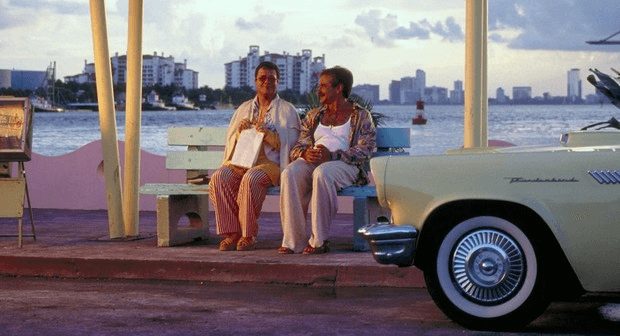
The Miami setting also gives the film a distinctive personality. The warm colors, nightlife atmosphere, and nightclub scenes create a vivid contrast with the stiff conservative world entering Armand and Albert’s home.
Elaine May’s Screenplay Balances Wit and Warmth
Elaine May’s screenplay is one of the film’s great strengths. The dialogue is sharp, but it rarely feels written only for punchlines. Characters talk past each other, misunderstand each other, and reveal themselves through the way they try to control the situation.
The script also gives the central relationship real texture. Armand and Albert bicker, panic, negotiate, and hurt each other’s feelings, but their bond feels lived-in. They are not presented as symbolic figures first. They are a couple, a family, and two people with years of shared history.
That emotional grounding is why the comedy works so well. The audience laughs at the absurdity, but the stakes still matter. Albert’s pain is real. Armand’s conflict is real. Val’s selfishness, even when understandable, has consequences. The film allows its characters to be funny without making their feelings disposable.
Themes of Family, Identity, and Acceptance
At its core, The Birdcage is a film about family. Not the polished version of family that people present in public, but the messy, loyal, complicated version that exists behind closed doors. Armand and Albert’s home may not look traditional to outsiders, but the film makes it clear that it is built on love, sacrifice, and commitment.
The story also explores identity in a way that remains meaningful. The characters are asked to hide, perform, exaggerate, or suppress parts of themselves in order to satisfy someone else’s expectations. That tension gives the film emotional weight beyond its comic setup.
The most interesting thing is that the film does not treat performance as false by default. Drag, theater, and self-presentation are shown as forms of expression. The real dishonesty comes from shame, denial, and public hypocrisy.
Humor That Still Lands
Comedy can age badly, especially when it is tied to social attitudes of its time. The Birdcage is not untouched by that issue. Some jokes and character choices reflect the era in which the film was made, and modern viewers may notice moments that feel broad or dated.
Still, much of the humor holds up because it is built on strong performances, tight timing, and character-based tension. The film does not rely only on topical references or cheap shock value. Its funniest scenes come from people desperately trying to maintain a lie while reality keeps pushing through.
The dinner sequence remains especially effective. It is the kind of extended comic set piece where every actor understands the rhythm, and every pause adds pressure. The humor grows naturally from the setup, which is why it still works.
Where the Film Shows Its Age
A balanced review of The Birdcage has to acknowledge that the film is very much a product of the mid-1990s. Its treatment of sexuality, gender presentation, and conservative politics was bold for a mainstream Hollywood comedy at the time, but not every element feels as fresh today.
Some viewers may find that certain jokes lean on stereotypes, even when the film’s overall attitude is affectionate and supportive. Val’s request that his father and Albert hide who they are can also be frustrating, though the film clearly understands the hurt behind it.
The pacing is mostly strong, but a few sections in the middle lean heavily into setup. Because the final act is so energetic, the earlier scenes sometimes feel like they are waiting for the full comic engine to start. Even so, the characters remain engaging enough to carry the build-up.
The Emotional Impact Beneath the Farce
What makes The Birdcage more than a polished comedy is the emotional sincerity underneath it. The film is loud, glamorous, and often ridiculous, but it is also deeply concerned with dignity. Albert’s desire to be seen as Val’s parent is not treated as a joke. Armand’s struggle between protecting his son and honoring his partner gives the story real emotional tension.
The film’s warmth is never heavy-handed. It does not stop every few minutes to explain its message. Instead, it lets the message emerge through behavior: who shows up, who sacrifices, who apologizes, and who finally learns to see beyond appearances.
That is why the film’s ending feels satisfying without needing to become sentimental. The comedy resolves, but the emotional point remains clear: family is not defined by public approval. It is defined by love, loyalty, and the courage to stand beside one another.
Overall Viewing Experience
The Birdcage remains a smart, funny, and emotionally generous comedy with standout performances from Robin Williams and Nathan Lane. It is stylish without being empty, broad without losing control, and heartfelt without becoming overly sweet. Mike Nichols’ direction keeps the farce elegant and fast, while Elaine May’s screenplay gives the characters enough depth to make the comedy matter.