I Love Boosters Review: Boots Riley Turns Fashion, Theft, and Rebellion Into a Wild Anti-Capitalist Comedy
I Love Boosters is the kind of film that announces its personality immediately. Loud, stylish, political, funny, messy, and deliberately strange, Boots Riley’s latest feature does not seem interested in playing by the clean rules of a conventional heist comedy. Instead, it uses the world of professional shoplifters, luxury fashion, and corporate greed as a springboard for a bigger, sharper conversation about ownership, exploitation, creativity, and who really gets to profit from culture.
Written and directed by Boots Riley, the filmmaker behind Sorry to Bother You, the film stars Keke Palmer, Naomi Ackie, Taylour Paige, Poppy Liu, Eiza González, LaKeith Stanfield, Will Poulter, Don Cheadle, and Demi Moore. NEON describes the story as following “a crew of professional shoplifters” who target a ruthless fashion figure, giving the film a playful crime-comedy setup with a much more rebellious political engine underneath it.
I Love Boosters Review: A Heist Comedy With a Political Pulse
At its simplest, I Love Boosters is about a group of shoplifters taking aim at a powerful fashion maven. But with Boots Riley, the simple version is never the whole picture. The film is built around the idea of “boosting,” meaning stealing and reselling goods, but Riley treats it less as a basic crime gimmick and more as a way to question the moral structure of capitalism.
The plot centers on a crew that moves through the luxury fashion world with speed, wit, and a sense of purpose. These characters are not presented as ordinary thieves looking for a quick payday. They see themselves as people pushing back against a system that has already stolen from them, whether through labor, design, identity, opportunity, or dignity.
That makes the film more interesting than a standard rob-the-rich caper. The shoplifting setup gives the story momentum, but the real subject is power. Who gets called a criminal? Who gets called a visionary? Who steals ideas and gets praised for business instinct? Who steals clothes and gets punished? I Love Boosters keeps circling those questions without turning into a lecture, even when its political message is impossible to miss.
Story and Spoiler-Free Plot Overview
The film follows a group of stylish, inventive women who target the upper levels of the fashion industry. Their world is one of resale hustle, bold disguises, luxury storefronts, and sharp social awareness. The conflict escalates when their creative work and identity become entangled with a powerful fashion mogul, played by Demi Moore.
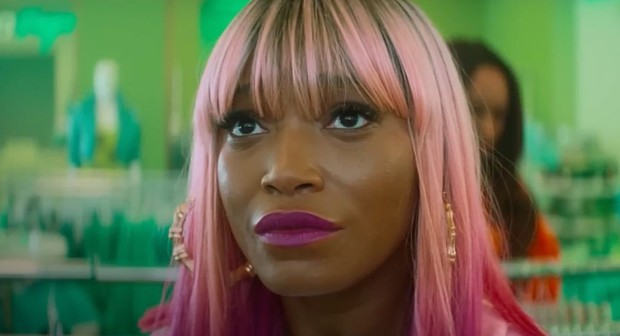
Keke Palmer leads the film as Corvette, a character who appears to carry both comic force and emotional pressure. Around her, the ensemble creates the feeling of a crew with its own rhythm, language, and code. Naomi Ackie, Taylour Paige, Poppy Liu, and Eiza González help shape the film’s group dynamic, while LaKeith Stanfield, Will Poulter, and Don Cheadle add extra texture to Riley’s offbeat cinematic universe.
The story is not designed as a neat, realistic crime drama. It is closer to a surreal satire with heist elements, fashion-world absurdity, and political fantasy. Reuters described the movie as blending “fashion, theft and revolution,” with Riley drawing inspiration from a song by his group The Coup and using the story to explore capitalism, consumerism, exploitation, and collective action.
Keke Palmer Gives the Film Its Center
A film this busy needs an actor who can hold its tone together, and Keke Palmer appears to be one of the main reasons I Love Boosters works as well as it does. Palmer has the rare ability to be funny without seeming lightweight and intense without draining the energy from a scene. That matters in a Boots Riley film, where the characters often have to move between comedy, anger, absurdity, and sincerity in the same stretch of dialogue.
As Corvette, Palmer gives the film a strong emotional and comedic center. She can sell the rebellious thrill of the crew’s mission, but she also brings enough humanity to keep the character from becoming just a symbol. In a movie full of ideas, Palmer helps make the ideas feel attached to a person.
Her performance also fits the film’s speed. Riley’s dialogue and visual style tend to move quickly. Jokes can turn into political arguments, and political arguments can become surreal comic set pieces. Palmer’s timing keeps the material alive without making it feel forced.
Demi Moore Makes a Strong Impression as the Fashion Villain
Demi Moore brings a different kind of energy to the film as the fashion-world antagonist. Her character represents more than personal greed. She stands in for a polished industry that profits from image, labor, and cultural borrowing while hiding its violence behind taste and branding.
Moore’s role seems designed to play with the elegance and menace of power. She does not need to be loud to feel dangerous. In a movie filled with maximalist color and movement, a controlled villain can be especially effective because she gives the chaos something to push against.
The casting also adds a useful layer. Moore has long been associated with Hollywood glamour, reinvention, and image-making, so placing her inside a satire of fashion and corporate control gives the performance a meta edge. The film benefits from that tension between surface beauty and underlying ruthlessness.
The Ensemble Brings Style, Chemistry, and Controlled Chaos
One of the clearest strengths of I Love Boosters is its cast. Naomi Ackie, Taylour Paige, Poppy Liu, and Eiza González each contribute to the crew’s sense of style and personality. A story like this depends on group chemistry. The audience has to believe not just that these characters work together, but that they have formed a small world of their own.
LaKeith Stanfield’s presence is also notable because he previously worked with Boots Riley on Sorry to Bother You. Stanfield fits naturally into Riley’s style of heightened reality, where a character can feel funny, mysterious, and politically loaded all at once. Don Cheadle and Will Poulter further broaden the film’s tonal range, giving the story more angles than a simple crew-versus-villain structure.
The ensemble nature of the film may be exciting for viewers who enjoy dense, unpredictable comedies. At the same time, it may also be one reason the movie can feel crowded. Riley often wants every supporting figure to represent an idea, a joke, a social position, or a visual statement. That ambition gives the film personality, but it can also make some characters feel more sketched than fully developed.
Boots Riley’s Direction: Bold, Uncompromising, and Very Much His Own
Boots Riley has a filmmaking voice that is easy to recognize. He is not interested in realism for realism’s sake. He prefers exaggeration, visual disruption, absurd humor, and political confrontation. I Love Boosters continues that approach, using the fashion world as both playground and battlefield.
The direction is energetic and intentionally overstuffed. Riley appears to treat every frame as an opportunity to push the film’s ideas further. Costumes, settings, performance style, and dialogue all seem to carry meaning. Nothing is neutral. A luxury garment is not just a luxury garment; it is labor, status, theft, desire, branding, and fantasy all stitched together.
That is what makes the film exciting. It feels alive with intention. But it is also what may divide audiences. Viewers who want a clean heist plot may find the film too restless. Those who enjoy surreal social satire will likely appreciate how far Riley is willing to push a premise that could have been much safer in another filmmaker’s hands.
Themes: Fashion, Labor, Class, and Who Gets to Own Creativity
The most interesting part of I Love Boosters is not simply that it criticizes capitalism. Many films do that. What makes Riley’s approach more specific is the way he connects capitalism to fashion, creativity, and visibility.
Fashion is often sold as self-expression, but the film asks what happens when self-expression becomes a luxury product. It looks at how trends move from the street to the runway, how designers profit from other people’s ideas, and how working-class style can be extracted, repackaged, and sold back at a price the original creators cannot afford.
That gives the film a strong cultural edge. The boosters are not just stealing clothes. They are moving through a system that has already blurred the line between theft and business. The film’s smartest idea is that legality and morality are not always the same thing. A corporation can exploit workers and call it supply chain management. A designer can borrow from marginalized communities and call it inspiration. A booster steals a jacket and gets labeled a criminal.
Riley does not pretend these contradictions are easy. Instead, he builds a comedy out of them.
Visual Style and Costume Design
For a movie about fashion, the visual design has to do more than look good. It has to tell the story. I Love Boosters appears to understand that. The costumes are not just decoration; they are part of the film’s language.
The clothing reflects personality, class, aspiration, rebellion, and performance. The crew’s style is expressive and tactical at the same time. They use fashion to blend in, stand out, disguise themselves, and make a statement. The luxury world around them is polished but predatory, full of surfaces that look beautiful while hiding uglier systems underneath.
The film’s color, texture, and movement give it a strong visual identity. At times, that maximalism may feel overwhelming, but it fits Riley’s purpose. A quieter film might have made the same political points with more restraint, but I Love Boosters wants the viewer to feel surrounded by excess. That excess is part of the critique.
Screenplay and Dialogue
Boots Riley’s screenplay is built around sharp ideas and heightened speech. The dialogue does not always aim to sound like ordinary conversation. Characters often speak with the rhythm of people who understand the politics of their world and are ready to argue about it.
That can be thrilling when the writing clicks. The film has the potential to turn a simple exchange into a joke, a manifesto, and a character beat all at once. Riley is especially good at finding comedy in contradictions. His characters often know they are trapped in absurd systems, and the humor comes from watching them try to outsmart those systems without losing themselves.
The weakness is that the screenplay may sometimes carry more ideas than the story can comfortably hold. Some moments can feel like they are racing ahead before the emotional weight has settled. For viewers already tuned into Riley’s style, that density may be part of the fun. For others, it may feel exhausting.
Pacing: Fast, Restless, and Occasionally Overloaded
I Love Boosters moves with the energy of a film that does not want to waste time. That pace suits the heist-comedy framework. The crew’s world is built on quick thinking, risk, and performance. The film’s rhythm reflects that lifestyle.
Still, a fast pace is not always the same thing as smooth pacing. Riley’s imagination is so active that the movie can sometimes feel like it is chasing three or four directions at once. There are moments where the satire, the comedy, the crime plot, and the political fantasy compete for attention instead of strengthening one another.
That does not ruin the viewing experience, but it does make the film less tidy than some audiences may expect. I Love Boosters is not a polished studio comedy designed to glide from setup to payoff. It is more jagged, more crowded, and more unpredictable. Whether that feels like a flaw or a feature will depend on the viewer.
What Works Best
The film is at its best when its style, politics, and humor are moving in the same direction. The central idea of shoplifters challenging a fashion empire is strong because it works on multiple levels. It is funny as a crime premise, satisfying as a revenge fantasy, and sharp as social commentary.
Keke Palmer’s performance gives the movie warmth and control. The ensemble adds flavor and speed. Demi Moore’s villain role gives the story a polished surface to crack open. Riley’s direction keeps the film from ever feeling anonymous.
Most importantly, I Love Boosters has a point of view. Even when it is messy, it never feels empty. It is trying to say something about the world, and it says it with color, volume, humor, and nerve.
Where the Film May Divide Viewers
The same qualities that make I Love Boosters memorable may also make it difficult for some audiences. It is not subtle. It is not especially restrained. It is not built for viewers who prefer realism, quiet character drama, or traditional heist-movie logic.
The film’s political message is direct, and its surreal style may feel like too much for anyone expecting a grounded crime comedy. Some jokes may land better than others. Some ideas may feel sharper than the scenes built around them. At times, the film’s ambition may exceed its emotional clarity.
But even when it stumbles, it does so in a way that feels connected to a real artistic vision. There is a difference between a film that is messy because it has no control and a film that is messy because it is trying to contain too much. I Love Boosters feels much closer to the second category.
Is I Love Boosters Worth Watching?
I Love Boosters is worth watching for viewers who like bold, political, visually expressive cinema. Fans of Sorry to Bother You will likely recognize Boots Riley’s taste for absurdist comedy, social critique, and genre disruption. Viewers interested in fashion satire, anti-capitalist storytelling, ensemble comedies, and unconventional heist films should also find plenty to enjoy.