
Backrooms Review: A24 Turns Liminal Horror Into a Quietly Unsettling Nightmare
Few modern horror ideas are as instantly recognizable as Backrooms. The yellow walls, buzzing lights, endless corridors, and feeling of being trapped somewhere that should not exist have become part of internet horror culture. What began as a strange online nightmare has grown into a full cinematic concept, and the biggest challenge for any Backrooms film is obvious: how do you turn an atmosphere into a story without explaining away the fear?
A24’s Backrooms, directed by Kane Parsons and written by Will Soodik, approaches that challenge with restraint. Rather than treating the concept as a simple monster movie or a loud jump-scare machine, the film leans into disorientation, silence, and the terrifying emptiness of spaces that feel almost familiar. A24 lists the film’s release date as May 29, 2026, with Chiwetel Ejiofor and Renate Reinsve among the lead cast, and its official synopsis begins with a strange doorway appearing in the basement of a furniture showroom.
Backrooms Review: A Horror Film Built on Atmosphere, Not Explanations
The strongest thing about Backrooms is that it understands what made the original concept frightening in the first place. The fear is not just that something might be hiding around the corner. The fear is that the corner itself should not be there.
The film uses its central location as more than a backdrop. The rooms, corridors, lights, carpets, and strange repeating architecture become part of the storytelling. Everything feels slightly wrong: too clean, too empty, too artificial, too endless. That uneasy feeling gives the film its identity.
Instead of rushing to explain every mystery, Backrooms allows the audience to sit inside confusion. That choice will work very well for viewers who enjoy slow-burn psychological horror, liminal spaces, found-footage tension, and science-fiction horror with an abstract edge. It may frustrate anyone expecting a more traditional horror plot with clear answers and constant action.
Story Overview: A Doorway Into the Unknown
The story begins with an ordinary setting: a furniture showroom, the kind of bland commercial space people walk through without thinking. Then a doorway appears where it should not be. From there, Backrooms moves into a dimension that feels like a memory of a building rather than a real place.
The film’s premise is simple enough to follow, but its emotional pull comes from uncertainty. The characters are not just searching for a way out; they are trying to understand the rules of a space that may not have rules at all.
That is where the movie finds its best horror. The Backrooms are not scary because they are obviously evil. They are scary because they feel indifferent. The environment does not behave like a haunted house with a clear purpose. It feels like a broken system, a place that accidentally caught human beings inside it.
Kane Parsons’ Direction Gives the Film a Distinct Voice
Kane Parsons brings an unusually specific visual language to Backrooms. His direction is patient, controlled, and deeply aware of how silence can become threatening. The camera often waits a little longer than expected, forcing the viewer to scan the frame for something that may or may not be there.
That approach makes the film feel closer to atmospheric horror than mainstream studio horror. There are moments of sudden panic, but the larger effect is slower and more invasive. The film works by making the viewer uncomfortable before anything actually happens.
Parsons also seems interested in scale. The Backrooms are not just a maze of hallways; they are a world with their own cold logic. Reports around the production have highlighted the large physical set built for the film, with PC Gamer noting discussion of a 30,000-square-foot Backrooms set that even surprised Chiwetel Ejiofor. That tactile quality matters. The film’s spaces feel lived in, even when they are empty, and that makes the nightmare more convincing.
Performances: Human Fear Inside an Inhuman Place
A concept like Backrooms could easily swallow its characters. The film avoids that by grounding the horror in human reactions: confusion, exhaustion, guilt, panic, and the desperate need to keep moving.
Chiwetel Ejiofor gives the film emotional weight. His performance works because he does not overplay the terror. He lets fear build in smaller details: hesitation before entering a room, the way his character listens for sounds that may not be real, the gradual loss of certainty as the space becomes harder to trust.
Renate Reinsve also fits the tone well. Her presence gives the film a quieter emotional intelligence, especially in scenes where the horror is less about immediate danger and more about psychological pressure. The film benefits from actors who can hold attention without needing big dramatic speeches.
The supporting cast, including names associated with the project such as Mark Duplass, Finn Bennett, Lukita Maxwell, and Avan Jogia, adds texture to the world without turning the film into an overcrowded ensemble piece. The focus remains on atmosphere and experience, but the human element keeps the story from becoming purely visual.
Cinematography: The Terror of Empty Space
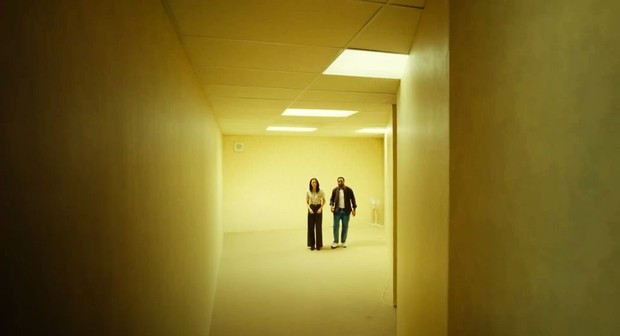
Visually, Backrooms is at its best when it trusts emptiness. The cinematography turns plain interiors into something deeply threatening. Fluorescent lighting, flat walls, wide corridors, and dull surfaces are used to create a sense of emotional suffocation.
The film does not need gothic shadows or extreme darkness to feel frightening. In fact, much of the horror comes from places that are too visible. You can see the hallway. You can see the corner. You can see the room ahead. The problem is that seeing clearly does not make the space safer.
That is one of the smartest visual choices in the movie. Backrooms understands that liminal horror is not about what is hidden in darkness. It is about being trapped in a place that looks harmless but feels completely wrong.
The production design also deserves attention. The familiar yellowish palette, repetitive patterns, and office-like emptiness could have become visually monotonous, but the film finds enough variation in scale, texture, and movement to keep the setting alive. The Backrooms feel endless without feeling lazily repeated.
Sound Design and Music: The Buzz Beneath the Fear
The sound design is one of the film’s most important tools. The low hum of lights, distant mechanical sounds, muffled echoes, and strange empty-room acoustics create a constant layer of tension. Even quiet scenes feel active because the space itself seems to be breathing.
The music is used carefully. It does not overwhelm the film or tell the audience exactly when to be afraid. Instead, it blends with environmental sound, making it difficult to separate score from atmosphere. That blurred line is effective because it mirrors the film’s larger uncertainty: is something really happening, or is the place slowly breaking down the characters’ sense of reality?
In a louder horror movie, silence is often just a setup for a jump scare. In Backrooms, silence becomes part of the threat.
Themes: Isolation, Memory, and the Fear of Meaningless Places
Beneath the surface, Backrooms is not only about being lost. It is about being trapped in a space with no clear history, no natural order, and no emotional warmth. That makes the film feel strangely modern.
The Backrooms resemble forgotten commercial architecture: offices, showrooms, corridors, storage areas, waiting rooms. These are places built for function, not comfort. By turning them into a nightmare, the film taps into a very specific fear: the fear of spaces that people created but no longer control.
There is also a strong theme of memory. The rooms feel like fragments of places people half-remember from childhood, work, shopping centers, hotels, and empty buildings. The result is not nostalgia, but discomfort. The film suggests that familiar spaces can become terrifying when stripped of people, purpose, and context.
Pacing: Slow-Burn Horror With Occasional Friction
The pacing of Backrooms is deliberate. This is not a film that races from one set piece to another. It wants the viewer to feel time stretching, the way it might stretch if someone were wandering through a place with no windows, no clocks, and no reliable exit.
That slow rhythm is mostly a strength. It gives the horror room to breathe and allows the environment to become genuinely oppressive. However, the film does occasionally risk becoming too restrained. A few middle sections may feel repetitive for viewers who are less invested in mood and atmosphere.
Still, the repetition often has a purpose. The film wants the audience to feel the exhaustion of endless sameness. Whether that works will depend heavily on the viewer’s patience for atmospheric horror.
Strengths: What Backrooms Gets Right
The biggest strength of Backrooms is its commitment to tone. It does not treat the source concept as a gimmick. It understands the uncanny appeal of liminal spaces and builds its horror around mood, scale, and uncertainty.
The film also benefits from strong visual discipline. It knows when to hold a shot, when to leave a frame empty, and when to let the audience imagine something worse than what is shown. That restraint gives the movie a more lasting sense of dread than a simple jump-scare approach would have.
The performances help as well. Chiwetel Ejiofor and Renate Reinsve bring seriousness and emotional control to a premise that could have felt thin in less capable hands. Their grounded reactions make the impossible setting easier to accept.
Weaknesses: Where the Film May Divide Viewers
The same restraint that makes Backrooms distinctive may also make it divisive. The film does not appear designed to answer every question or neatly explain its mythology. Viewers who want a clear lore-heavy breakdown may leave wanting more.
The story can also feel secondary to the atmosphere. That is not necessarily a flaw, because the Backrooms concept is naturally environmental, but it does mean the emotional arc sometimes competes with the world-building. The film is more powerful as an experience than as a conventional narrative.
Some viewers may also find the slow pace challenging. The movie asks for attention and patience. It is less interested in delivering constant shocks than in creating a mood that lingers.
Overall Viewing Experience
Backrooms is a horror film for viewers who enjoy dread more than spectacle. It is eerie, controlled, and often visually hypnotic. Its best scenes capture visually hypnotic. Its best scenes the feeling of being somewhere you recognize but cannot explain, surrounded by architecture that seems ordinary until it becomes impossible.
As a big-screen adaptation of internet horror, it succeeds by avoiding the most obvious trap. It does not simply copy the aesthetic and stretch it into a feature. It tries to translate the feeling behind the aesthetic: loneliness, confusion, and the terror of being trapped in a space with no human logic.
The film may not satisfy every horror fan. Those looking for fast pacing, clear answers, or heavy creature-feature energy may find it too quiet. But for viewers drawn to liminal horror, psychological tension, and atmospheric science-fiction dread, Backrooms offers a strong and unsettling cinematic experience.
Verdict
Backrooms is a stylish, patient, and genuinely unnerving horror film that turns empty rooms and endless corridors into a source of real cinematic dread. Its mystery-first approach will divide audiences, but its atmosphere, performances, sound design, and visual control make it one of the more intriguing modern horror adaptations of internet-born mythology.