
Project Hail Mary Review: Ryan Gosling Leads a Smart, Warm, and Surprisingly Human Sci-Fi Adventure
Project Hail Mary arrives with a difficult mission of its own: turn Andy Weir’s beloved science-fiction novel into a big-screen adventure that can satisfy readers, entertain newcomers, and still hold on to the story’s mix of hard science, humor, isolation, and emotional discovery. The result is a polished, crowd-pleasing space film that understands the heart of Weir’s premise, even when it occasionally softens the sharper edges of the material.
Directed by Phil Lord and Christopher Miller, written for the screen by Drew Goddard, and led by Ryan Gosling as science teacher Ryland Grace, the film is built around a classic survival hook: one man wakes up on a spacecraft with no memory of who he is, why he is there, or what has happened to Earth. As his memories return, he realizes that humanity is facing an extinction-level crisis, and he may be the only person capable of helping stop it. The film is based on Weir’s 2021 novel and also stars Sandra Hüller, Lionel Boyce, Ken Leung, and Milana Vayntrub.
Project Hail Mary Review: A Space Mission Built on Mystery, Science, and Heart
The strongest thing about Project Hail Mary is how quickly it turns a potentially heavy science-fiction setup into an accessible emotional journey. Ryland Grace is not introduced as a swaggering astronaut or a typical action hero. He is a teacher, a problem-solver, and a reluctant participant in a mission far bigger than himself. That gives the film a welcome human scale, even when the story stretches across light-years.
The opening works because it places the audience inside Grace’s confusion. He wakes up alone, surrounded by technology he does not fully understand, while fragments of memory begin to return. The film uses that amnesia structure as more than a gimmick. It becomes a way to reveal the story piece by piece, shifting between the present-day spacecraft mystery and the earlier events on Earth that led to the mission.
That structure keeps the film moving, even during scenes that are largely built around science, observation, and experimentation. Like The Martian, another Andy Weir adaptation, Project Hail Mary finds drama in problem-solving. The tension often comes not from explosions or space battles, but from whether Grace can understand a system, test an idea, make a calculation, or survive one more impossible obstacle.
Story Overview: A Teacher, a Dying Sun, and an Impossible Mission
The plot follows Ryland Grace, a science teacher who wakes aboard an interstellar spacecraft with no memory of his identity or mission. As he slowly pieces things together, he discovers that a mysterious substance is draining energy from the sun, threatening life on Earth. His mission is to investigate the crisis and search for a way to save humanity. Along the way, the story introduces an unexpected friendship that becomes central to the film’s emotional weight.
The film wisely avoids turning that premise into a bleak disaster movie. There is danger, loss, and fear, but Project Hail Mary is more interested in curiosity than despair. It treats science as a form of hope. Every experiment matters. Every discovery opens a new door. Every failure teaches Grace something he needs to know.
That approach gives the film an optimistic tone without making it feel naïve. The stakes are enormous, yet the best scenes are often intimate: Grace thinking aloud, testing theories, recording observations, or trying to understand a world that no longer makes sense to him.
Ryan Gosling as Ryland Grace: Funny, Fragile, and Easy to Root For
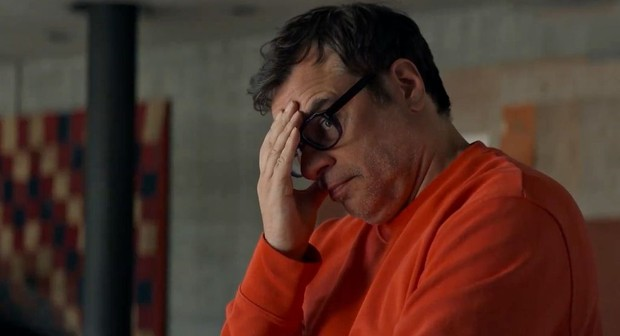
Ryan Gosling is the film’s anchor, and the role suits him well. Grace needs to be intelligent without becoming smug, frightened without becoming helpless, and funny without turning the crisis into a joke. Gosling finds that balance with a performance that feels loose, anxious, and quietly sincere.
He brings his familiar comic timing to the role, especially in moments where Grace reacts to the absurdity of his situation. But the performance works because the humor is usually grounded in fear. Grace jokes because he is overwhelmed. He talks to himself because there is no one else around. He leans on science because it is the only thing keeping panic from taking over.
The film also gives Gosling room to show vulnerability. Grace is not a fearless explorer. He is a man forced into a situation that would break most people. His intelligence matters, but so does his capacity for empathy. As the story develops, that empathy becomes just as important as his scientific knowledge.
Sandra Hüller and the Earthbound Story
Sandra Hüller brings sharp authority to the film’s Earth-based storyline. Her character, Eva Stratt, represents the political and moral pressure behind the mission. She is practical, unsentimental, and focused on survival at any cost. That makes her a strong counterweight to Grace’s more humane, uncertain perspective.
The Earth scenes could easily have felt like interruptions, but they help widen the scope of the story. They show the desperation behind the mission and the compromises people make when the future of the planet is at stake. Hüller gives these scenes a necessary seriousness, preventing the film from becoming too light or too self-satisfied.
Still, the Earthbound material is not always as emotionally rich as the space storyline. Some supporting characters feel more functional than fully developed, and certain decisions are presented with less complexity than they deserve. The film is strongest when it lets moral tension breathe; it is weaker when it rushes through the human consequences behind those decisions.
Direction: Lord and Miller Balance Big Sci-Fi with Playful Energy
Phil Lord and Christopher Miller bring a noticeably bright, kinetic sensibility to Project Hail Mary. Their background in films such as The Lego Movie and the Spider-Verse franchise can be felt in the film’s sense of pace, visual imagination, and willingness to make scientific discovery feel playful rather than dry.
This is not cold, minimalist science fiction. It is colorful, emotional, and often openly funny. The directors understand that wonder is one of the genre’s greatest tools. Space is not just empty darkness here; it is frightening, beautiful, strange, and full of possibility.
At times, that playful energy becomes a double-edged sword. Some scenes lean heavily into charm when a quieter approach might have carried more weight. The film wants to be thrilling, funny, moving, and family-friendly all at once, and for the most part it succeeds. But there are moments when the tonal shifts feel a little too smooth, as if the film is reluctant to sit too long with discomfort.
Screenplay and Adaptation: Drew Goddard Keeps the Science Clear
Drew Goddard’s screenplay does one of the hardest things in mainstream science fiction: it makes complex ideas understandable without stopping the story cold. The film deals with biology, astrophysics, engineering, communication, and survival math, but it rarely feels like a lecture.
The script uses Grace’s teaching background cleverly. Because he is used to explaining science in simple terms, the exposition often feels natural. He is not just solving problems for himself; he is translating them for the audience. That gives the film a clean, readable rhythm.
Fans of Andy Weir’s novel may notice changes in tone and emphasis. The film version is more openly cinematic, more sentimental in places, and more eager to shape the material into a broad theatrical adventure. Some of that works beautifully. Some of it makes the adaptation feel a little safer than the book’s more detailed internal logic. But as a film, Project Hail Mary understands the core appeal: intelligence, cooperation, and hope under impossible pressure.
Visuals and Cinematography: Space with Scale and Texture
Visually, Project Hail Mary is built for the big screen. The spacecraft interiors feel functional without becoming dull, and the wider space sequences have a clean sense of scale. The film uses visual effects not only for spectacle, but also for mood: isolation, distance, danger, and discovery.
The production design helps sell the mission as something urgent and practical rather than sleek fantasy. The technology feels designed for survival, not glamour. That gives the film a more grounded texture, even when the story moves into extraordinary territory.
The film was presented as a theatrical experience, with Amazon noting that it was filmed specifically for IMAX. That large-format ambition fits the material: the story needs both the vastness of space and the closeness of human connection.
Music and Sound: Emotion Without Losing Momentum
The score supports the film’s optimistic tone without overpowering it. The music rises during moments of awe and danger, but the most effective passages are often the quieter ones, where the sound design emphasizes the loneliness of Grace’s mission.
A film like this depends heavily on rhythm. Silence, machinery, breathing, alarms, and communication attempts all become part of the emotional texture. Project Hail Mary uses sound to make space feel both empty and alive. It reminds us that survival is not only visual; it is also something Grace hears, measures, and interprets.
Themes: Science, Friendship, Sacrifice, and Hope
At its heart, Project Hail Mary is not just about saving Earth. It is about the idea that intelligence means little without cooperation. Grace’s greatest breakthroughs do not come from genius alone. They come from communication, patience, trust, and the willingness to see another being as more than a problem to solve.
The film’s most moving theme is friendship across impossible distance. Without spoiling the story’s best emotional turns, the relationship at the center of the film gives Project Hail Mary its soul. It turns a survival narrative into something warmer and more surprising: a story about connection forming where connection should not be possible.
There is also a strong moral question running beneath the adventure. What is one life worth when weighed against billions? What choices become acceptable when extinction is on the table? The film raises these questions clearly, although it does not always explore them as deeply as it could. Its instinct is to move toward hope rather than ambiguity.
Pacing and Runtime: Engaging, Though Occasionally Overextended
At 2 hours and 36 minutes, Project Hail Mary is a long film, and it occasionally feels its length. Most of the runtime is justified by the layered structure and the gradual reveal of Grace’s mission, but a few middle sections could have been tighter.
The film is most compelling when discovery and emotion are working together. It slows slightly when the humor stretches too long or when flashbacks repeat information the audience has already understood. Even so, the pacing rarely collapses. Lord and Miller keep the tone lively, and Gosling’s performance makes even the quieter stretches watchable.
The final act aims for a big emotional payoff, and for many viewers it will land. Others may find it a little too polished, even a little too determined to send audiences out feeling uplifted. That is part of the film’s identity: it is not cynical science fiction. It wants to believe in people, in learning, and in the possibility that cooperation can save us.
Strengths: What Project Hail Mary Does Best
The film’s biggest strength is its emotional accessibility. It takes a high-concept science-fiction premise and turns it into something approachable without making it feel dumbed down. The science matters, but so do fear, humor, loneliness, and kindness.
Ryan Gosling’s performance is another major asset. He carries long stretches of the film with little traditional interaction, and he makes Grace feel like a real person rather than a heroic symbol. His charm helps, but the performance is strongest when it lets Grace seem uncertain and emotionally exposed.
The film also succeeds as a theatrical sci-fi adventure. It has scale, visual polish, and enough wonder to justify the big-screen treatment. The positive critical response has largely emphasized that mix of spectacle and heart, with Rotten Tomatoes summarizing the reception around the film’s visual ambition, Gosling’s appeal, and its balance of intelligence and emotion.
Weaknesses: Where the Film Falls Short
The main weakness is tonal softness. Project Hail Mary sometimes avoids the darker implications of its own story. The extinction threat is massive, but the film often moves through it with buoyant energy. That makes it entertaining, but it also reduces some of the dread and philosophical tension that could have made the film hit harder.
Some supporting characters are also underused. Sandra Hüller brings weight to her role, but the film’s focus remains so firmly on Grace and the mission that parts of the Earth storyline feel compressed. Viewers who want a more morally complicated adaptation may wish the screenplay had spent more time with the consequences of its biggest decisions.
The humor will also divide some audiences. Much of it works because Gosling sells it with warmth and timing. But a few jokes arrive when the story might have benefited from restraint. The film’s lighter tone is part of its charm, yet it is also what keeps it from becoming truly haunting.
Overall Viewing Experience: A Big, Sincere Sci-Fi Crowd-Pleaser
Project Hail Mary is the kind of mainstream science-fiction film that feels increasingly rare: smart but not cold, emotional but not empty, funny but not careless, and spectacular without losing sight of character. It may not satisfy everyone who wanted a tougher, more philosophically thorny adaptation, but it works remarkably well as a generous theatrical adventure.